D2D at TAB 2026 in Austin, TX
We are excited to launch several new products at TAB 2026 in Austin this week!
D2Live is our new live streaming platform built for schools, local broadcasters, and state disaster response personnel who want to get a game or news event online and over the air — without needing a full production crew or an IT department. Just point your phone with our D2Cam SRT streaming app, hit start, and you’re live with multi-camera angles and instant highlight clips, all published to your website, a browser-based viewer, or behind a paywall for revenue-generating events. You can even stream it to our D2Flex multiplexers at the transmitter for over-the-air breaking news alerts. We also provide URLs for each camera so you can bring the feeds into your own studio production equipment.
We’ll be demonstrating D2Live at TAB by live streaming from the TAB golf tournament Wednesday morning and from the booth on Thursday. Go to d2dtechnologies.com/d2live to watch live or see the most recent recording. There is also an Event Viewer which lets you browse all recordings and highlights from the event.
D2Distro is our new ad distribution platform for delivering ad content to broadcasters or digital signage devices. Just upload your ad content and select which endpoints it needs to go to. The client-side app pulls the content and places it wherever the broadcaster chooses. We also QA the content to make sure it matches the codec parameters needed at the destination.
D2Flex1K is our new endpoint streaming decoder. In addition to decoding any standards-based IP stream (SRT, HLS, etc.), it can do overlays, crawls, and L-bars for side-panel banner ads. It’s also a cost-effective SRT confidence monitor — and will soon be available for purchase directly from our website.
Come see Jon and I at booth 102 to learn more about D2Live, D2Distro, and D2Flex1K.
Happy Holidays 2023
Merry Christmas and Happy Holidays from D2D Technologies!
Jess (00:00)
Hi, John. Steve. Merry Christmas.
Jon (00:03)
Merry Christmas, Jess.
Steve (00:05)
Merry Christmas, Jess.
Jess (00:07)
Hey, guys. It’s been such a great year. 2023 was absolutely amazing for D 2d technologies and we have so many great customers, some older customers, some newer customers, but all of them are just the best customers in the world. And I’m trying to think of something to do for them. I’m thinking maybe if I could knit them all socks or give them all a sweater or something, but I’m at Wits end. What can we give our customers, Steve, for 2024?
Steve (00:31)
Well, Jess, I actually have the perfect holiday gift. SRT redundancy! We’ve come out with this great new feature for the Flex 3500 and the Flex 5220. Let me explain a little bit how it works. So imagine you’re a station and you have two transmitters and you have a link going from the studio of the transmitter A and a link going from the studio of the transmitter B. You can also then set up SRT links between the transmitters. So if the link goes down from the studio of the transmitter a, transmitter a will automatically roll over and pull the stream from transmitter b. But that’s not all. If for some reason, the reason the link went down is the Internet is just totally down at transmitter a, you can have it set that if all the SRT links are down, it’ll actually roll over to a file that you’ve uploaded to the unit, which will be a loop. You could have technical difficulties, whatever video you want to have, just looping so that you’ll always be on the air, even if you have no Internet connections.
Jess (01:29)
Oh, fantastic. So no matter what, our customers won’t go dark, correct?
Steve (01:33)
Yeah, even if there’s no Internet access at all, they’ll still be on the air.
Jon (01:37)
So you mentioned the Flex 3500 and the Flex 52 20, but what if they only have a 3000?
Steve (01:45)
That’s a great question, John. And we wanted everybody to take advantage of this great new feature. So what we’re going to do from now through the end of January is offer a 15% discount on anybody who wants to upgrade from the Flex 3000 to the Flex 3500. So everybody can always remain on the air.
Jon (01:37)
So you mentioned the Flex 3500 and the Flex 52 20, but what if they only have a 3000?
Steve (01:45)
That’s a great question, John. And we wanted everybody to take advantage of this great new feature. So what we’re going to do from now through the end of January is offer a 15% discount on anybody who wants to upgrade from the Flex 3000 to the Flex 3500. So everybody can always remain on the air.
Jess (02:02)
Wow, perfect. A 15% discount on an upgrade from a base unit to a 3500 for the rest of January. So all of January. That’s a great gift, Steve. That’s the best thing ever.
Steve (02:22)
Right. So all you got to do is just click below, call us, hit our website, send a smoke signal, play the telephone game, whatever. Just contact us. We’ll get you all squared away.
Jess (02:33)
It’s a great gift. We couldn’t offer anything more for our wonderful, wonderful customers. And it’s going to be a fantastic 2024. I hope everybody stays tuned.
Jon (02:42)
Oh, me, too. I really hope everybody has a wonderful holiday and a merry Christmas.
Steve (02:47)
Merry Christmas, everybody. For all of us here at D to D. Ho ho
Get SuperFrank’s insights on the FCC + EAS for LPTV [D2D webinar replay]
As the FCC starts to crack down on non-compliance, who better to get the low-down on maintaining EAS compliance for your LPTV station than “SuperFrank” Copsidas?
As president and founder of LPTV Broadcasters Association, and the owner of 10 LPTV stations, SuperFrank meets regularly with the FCC on topics including compliance. He was the star of our recent webinar: “How to Make Your EAS Insertion Easy and Affordable.”
If you missed the live conversation with SuperFrank, you can catch the replay here.
You’ll get SuperFrank’s insight into what folks at the FCC are most concerned about, the most critical challenges right now, and some solutions on the horizon for LPTV owners. You’ll also get practical advice you can use now and going forward. You’ll hear how you can:
- Automatically monitor EAS digital video signals for valid alerts and insert them into programming as appropriate until the alert is complete
- Easily configure the digital EAS elements to be used for insertion
- Selectively insert nationwide and local alerts on the channels you want in order to provide the coverage you need in your local market
SuperFrank covered a lot of ground, so this webinar is a great way to catch up quickly! If you have any questions after watching, just call or email. We’ve gotten a ton of interest in simple, affordable EAS compliance solution for LPTV stations, and we’d be happy to help you implement a solution and avoid hefty FCC fines!
D2D on KitPlus
Watch the KitPlus interview for the fastest and easiest switching solution
Don’t you love it when you find out there’s a new solution to a problem you have all the time?
If you’re using SRT to send your broadcast signal to local stations, you have likely encountered a common problem. After many of you asked for a solution, D2D, an openGear partner, created one that is not only fast and easy, it’s cost effective too.
KitPlus just posted an interview with D2D’s Jessica Colyer, where they break down why our latest innovation is a solution people have been clamoring for. It’s a great conversation you can watch in just a few minutes, so don’t miss it.
D2Switch switches your transport stream after it has left the station in 3 convenient ways: you can log in and tell it to switch, you can set a time to switch on demand, or you can use GPIO contact closure to trigger it.
This simple and effective switching solution is compatible with openGear products, significantly more affordable than other options out there, and it solves 3 common problems:
-
You need to cut away from the prime time feed – maybe for ads, maybe for local news, or maybe you’re approaching a licensing issue. With D2Switch, you can cut away to local content or another SRT stream from anywhere with the touch of a button on the switcher. It couldn’t be easier. Even if live programming overruns, D2Switch allows for full control to override a scheduled switch, even if you are not in the same location as the unit using D2Manage.
-
You probably already know that local ID insertion is very expensive. It can easily require $30,000 to 40,000 worth of equipment. D2Switch allows you to automatically switch and show the station ID, then go back to regular programming. Not only is this solution much more cost effective, it allows you to easily display your station branding and remain compliant.
-
If the internet isn’t reliable, there’s a network jitter, or another network issue, D2Switch provides hit-less redundancy, automatically switching to another source. This is a problem many of you have wanted a solution for, and D2Switch is that solution.
Watch the interview on KitPlus to find out more.
D2D is fine-tuning and beta-testing D2Switch right now, so if you’re interested in getting started with it, get in touch with our partners at D2D.

Steve Doll talks with KitPlus.tv
Matt:
Hello, and welcome to the show brought to you with the support of media proxy. Today. We’d like to welcome Steve doll from D two D technologies. Hi, Steve. Welcome to the show.
Steve:
Oh, thank you, Matt and Simon. Thank you for having me here today.
Simon:
It’s good to see you. So, Steve, we’re going to be talking about, uh, PBS war today. Um, we’re going to come onto that in just a minute before we get started. Tell us a little bit about D2D and what you do.
Steve:
Sure. So D2D technologies, we’ve been around for almost 20 years. We have a background in multiplexing and some of the areas, in addition, multiplexing we do is, um, yeah, EES insert that’s an emergency alert system, insertion program guidance insertion also do a lot of sending transport streams around the country using the public internet, using the SRT protocol.
Matt:
Okay, great. Yeah. So brings us neatly then onto, onto the PBS warn system. What, what is it?
Steve:
Sure. So first, let me give you a little background of what PBS is for some of your international viewers who may not be aware. It’s a private nonprofit organization, uh, and partnership with almost 200 member stations around the country. And their mission is to provide high-quality content which educates, inspires, and entertains. They have a lot of great programming, including educational children’s programs, arts, and theater uh, documentaries, international programs. Remember when I was, young, that PBS was the first place I saw C great British show, such as Monty Python and, Dr. Who <laugh> and there you go. Fantastic. So they had, contacted us a couple of years ago, but a project there wanted to do called the PBS Warren system, a Warren stands for warning alert and response network, and basically what it is, is a backup to the emergency, uh, alert system, the wireless emerging, uh, alert system, those messages you get on your phone, uh, periodically.
Steve:
And the way that normally works here in the United States is the different government entities will send the messages over the public internet to the wireless providers, such as Verizon AT&T. And then they will basically send the messages out to whatever different phones are in that geographical area. But the question becomes what happens if the internet style, how do we get those messages out to your phones? That’s where PBS comes in. The alert messages will also go to the PBS satellite up link, where they’re sent to over satellite, to all the PBS stations around the country, where then each site, our D two Warren system will take the alert messages out of the satellite feed and inject it into the PBS over the air local, uh, local broadcast. And those yeah, uh, transmission be picked up by the, the wireless carriers.
Simon:
So what are the key requirements of the system of
Steve:
Sure. First of all, the one thing that was very important from the beginning that PBS really emphasized was do no harm, um, that, you know, we don’t wanna do anything to the regular over the air broadcast. So the first step we did with that, we use opportunist opportunistic injection, where we basically replace the null packets in the stream with the alert messages. So we don’t actually modify any of the data in the stream. It all had to be very robust. Uh, so we had kind of two modes of fail-safe, and a failover. Basically, what fails safe does is if there’s some sort of, uh, CATA, uh, issue where the, uh, the hardware just, uh, you know, loses power, or if some reason fails, it’ll still pass the signal through uninterrupted. We also had, uh, fail over, which is where if the, uh, primary inserter failed, it would fail over to a backup and also required SMP for communicating between the two servers and also for remote monitoring.
Steve:
This also needs to be a single-unit solution. This is where the Ross openGear was a key component of the system. So we’re able to put two of our insertion cards, plus two satellite cards, all within a single two UR frame, uh, supplied by, uh, the Ross openGear frame. I also had to have alarm and status indicators. And one of the other key functionalities that required was flexibility and functionality. As I mentioned before about PBS and something I didn’t realize until we were actually doing this project is PBS. Doesn’t actually own the stations. They’re all actually member stations. So each one is unique. There’s kind of a same within PBS that if you’ve seen one PBS station, you’ve seen one PBS station. So we had to handle different stations and ASI some IP, some 73, 10, some a combination of all three. So it’s quite a bit, different situations you had to be prepared for once the system was deployed.
Matt:
So, that’s interesting. What, was the process? What were the key steps in? Cause it sounds interesting getting, you know, warning signal up to satellite, and then down, via TV signal and then out into the mobile network, what’s the process how’d you start to, develop that kind of tool?
Steve:
Sure. So once we awarded the contract, we spent about three months, it’s earning out the statement of work, and it’s not only a technical process but also had to get upper management approval legal teams involved. Uh, and one of the things we did during that process, which became very, important was we built in some pre-approved funding for unanticipated features, modified functionality, cuz just sometimes, you know, you, you have this great plan, but once you start implementing realize it doesn’t quite work the way, you were expecting to. So it’s good to have this sort of built in so that when these situations came along, you didn’t have to go through that whole process. Again, of getting all the upper management involved legal teams involved. We only had to get approval from the PBS Warren team that we were working with.
Steve:
And once we had that at statement of work, the next key step was to break that up into task of milestones, which could be easily managed. We actually used the JIRA management system for our project management and it’s very important also to have an iterative process. We had weekly meetings and code updates with the PBS warrant team. We worked very closely. So that way they could see week by week, how the project was coming along, they could test it in their own. They had a demo unit at their site. They can be tested when we want along. So that way we can really keep track of that. We’re on schedule, it’s working, how they’re supposed to. And this is where kind of as saying the having that pre-built in funding is as we’re going along, we ran into this issue called rain fade. It’s not familiar with that.
Steve:
That’s with satellite reception rainy conditions, the signal can go in and out. And we first started testing that was causing it to fail over to the backup quite often. So we had to kind of go in and, and tweak things a bit so that we had a better, uh, understanding of when it was just rain fade and not an actual failover. So we wouldn’t fail the system over. Mm. And once you have a system ready to go, uh, it works great in our lab, works great in the PBS lab, but you really need to get it out in the real world. So we had about 10 stations, uh, lined up for beta testing and it was really nice cuz we had a mix of somewhere. I had I some more IP, some more hybrids. We can actually see the system working in different environments before we actually fully deployed it.
Steve:
Then after it’s deployed, uh, things aren’t over yet, cuz the really, probably the key thing is support. You know, making sure, you know, we’re always there, if there’s any issues, uh, we, we support it. We add enhancements. Uh, we actually, uh, it’s not once we got the, the system out and started giving feedback from the individual stations, um, they’d be like, oh, it’s working great. It’d be really nice that did this. We took all that feedback. And about six months after it was deployed, we did another update to kind of take in all that user feedback. So
Simon:
Steve, how, how important was the open gear element in the project?
Steve:
Critical. It’s kind of under saying that those kind of, one of the key features in hu being award of the contract was to have it the whole solution within a single product. So even though it was redundant, there was two of everything. It was still all in one single to U frame. And that was definitely the feedback we had from PBS was that was, is a major, uh, decision point in us getting the contract.
Simon:
The Tod technologies has been around it for quite a while. I can’t believe this is the first custom project you’ve done. Tell us about some other work you you’ve been involved in.
Steve:
Sure. There’s a couple others, uh, which come to mind, uh, there’s three angels broadcasting, which is religious broadcaster here in the states and they were doing a satellite distribution that we had our equipment, each site receiving over the, or the satellite feed. But one thing they needed to do for government compliance was to be able to insert alert messages, and they didn’t wanna go through the expense and the quality, uh, uh, degradation by decoding and recoding it site to put the alert message in. So we came up with a method to basically take the alert message, uh, replace all the programs in the stream with the alert message for the duration. Then it’s done switch everything back. So that way they can be compliant without having to decode and reco re-encode at each location. Another custom project we did was in Mexico, uh, a system and we had called D2propel where they were also doing a site like distribution.
Steve:
And in this case at each site, they did knew that did need to do a decode and recode cause they’re inserting local content at each location. But the one issue they had though is they needed program guide information and it was the same program guide information, every location. But since they’re doing a decode Recode, if they did the, uh, program guide generation at the uplink, it would all be lost. And they, so they’re looking at the expense of having to put in a generation, uh, at each location, which would be very expensive and very redundant, cuz it’d all be the same guide information. So what we did with our system, which is already deployed at each site was we took the satellite feed in with the guide information. We take the guide information out, send it out our first output to be decoded recoded for local content. Then we take it back in our second input, put the guide information back in and send it out our second output to go into transmitter for broadcast. So that way they can only have one, uh, guide generation at the uplink and not have to have that added expense of having one at every, uh, location.
Matt:
Yeah, I think I partly was to also see whether you’ve learn anything over the years of doing all of these, uh, custom projects. They must, you must have identified some, some sort of some vital, some key elements that you and both you and the customer need to achieve. Sure. When you are entering into a custom project like this,
Steve:
Correct? Yeah, yeah. Here at D2D, we love doing custom projects. It’s, it’s very challenging. We really like that working one on one with the customer and also being a small, nimble company. It it’s nice that, uh, you know, basically with the PBS project, it’s pretty much involved in, in every, uh, phone call and meeting. So if something needs to be changed, it doesn’t have to go up through four levels of management to somebody who’s not even involved in the project to make a decision. You know, I can make the decision right there so we can be very flexible. But some of the other keys, uh, we learned, uh, was that, well, it’s important to have a, a very detailed and comprehensive statement of, of work that you should build in flexibility, cuz there’s always things that you didn’t think of or, you know, you thought would work one way, but once you actually implemented it doesn’t quite work the way you thought. So you want some flexibility built-in. You also wanna be able to break that statement of work down to smaller tasks, which would be easily manage and track. We wanna very iterate. We work closely with the, the customer. So ensure the project stays on the schedule and it’s meeting what they’re actually looking for. It’s also good that before you actually do full deployment, you wanna do some beta testing, some real world environments. Then finally just the ongoing support, uh, and enhancements based on customer feedback.
Simon:
Yeah. That’s so some good, good, good advice, sir. Steve, thank you very much indeed. For your time today, today, it’s been great talking to you. Um, you’re welcome learning about and learning about your solutions and also the open gear solutions as well. And on the point of open gear, you can check out a channel for the other other openGear partners that we’ve been chatting to over the last couple of months. Do, um, also go to D2Dtechnologies.com, where you can find everything that, uh, Steve’s been talking about. And also there’s a full-length case study on there as well. Thanks to media proxy for their support care plus TV. And thank you for watching. We’ll see you next time.
D2D Technologies to supply public television stations with equipment to support Wireless Emergency Alert System
Download press release here (PDF).
Jacksonville, FL – September 5, 2019 – D2D Technologies today announced that the company was selected by the Public Broadcasting Service (PBS) as their vendor partner to supply a customized solution to all public television stations for the insertion and broadcast of emergency message data that complies with upcoming FCC mandated changes to the Wireless Emergency Alert (WEA) system.
The nationwide PBS WARN system provides a resilient and reliable broadcast-based message path that ensures delivery of all Wireless Emergency Alerts and is the largest public safety program currently undertaken by PBS. PBS WARN’s role in improving the overall resilience and cybersecurity of the WEA system have been noted by the Federal Communications Commission (FCC) in their Communications Security, Reliability, and Interoperability Council (CSRIC)’s most recent report on “Comprehensive Re-Imagining of Emergency Alerting.” The CSRIC noted the PBS WARN program is “well positioned to provide an immediate alternate source of inbound WEA messages” for cellular carriers who have opted to deliver wireless emergency alerts to their customers[1].
The updated solution supplied by D2D Technologies will support PBS’ ongoing participation in the Wireless Emergency Alert system, with capability to process the essential new alert options required by the FCC, including: increased message length of up to 360 characters; embedded clickable hyperlinks; new “blue alerts” to notify the public of threats to law enforcement; and greater geographical accuracy of all alerts. The equipment comes with five years of support and warranty services, which will ensure that stations continue to provide this public service for the foreseeable future.
Dana Golub, Vice President of Programs Management for PBS and Executive Director of the PBS WARN program notes, “Public safety is mission-critical for public television and identifying the right solution to complete such an important update to the Wireless Emergency Alert system is a meaningful step.”
“America’s Public Television Stations look forward to working with PBS and D2D Technologies to enhance and enlarge our public safety mission,” said Patrick Butler, APTS president and CEO. “We are doing more every day in emergency communications at the national, state and local levels, and this new generation of technology will make it possible for us to perform this mission even more reliably and comprehensively.”
The solution supports ASI, SMPTE-310, and TSoIP I/O with full failover capabilities in a 2RU frame to ensure that WEA messages continue to be reliably inserted into the PBS broadcast stream. It also will feature multiple input/outputs to support additional alerting at the local and/or national level.
“We are very excited that PBS selected us to deliver a PBS WARN solution to public television stations based on our proven D2Flex video multiplexing technology that will reliably insert WEA data with pre-emptive priority for Presidential messages”, comments Steve Doll, President of D2D Technologies. “We look forward to working with PBS in delivering the station-level solution and serving the public television stations for years to come.”
About the PBS WARN Solution
The system from D2D Technologies is a fully integrated 2RU solution that receives Wireless Emergency Alert (WEA) messages sent via the PBS Satellite Interconnection System and reliably inserts the designated message PID(s) into the broadcast transport stream with full failsafe and failover capabilities. The system is built around the D2Flex OG-3000 for openGear broadcast quality full duplex IP/ASI video processor that faithfully handles the grooming, PID insertion, monitoring and alerting for the system. By using a fully redundant Receiver and Groomer pair, the system can continuously monitor and automatically failover from main to backup to guarantee that the WEA messages continue to be inserted into the broadcast stream. The D2WARN solution is designed to be easily installed and operated by public television stations with configurations for ASI, SMPTE-310M, and TSoIP input and output.
About D2D Technologies
D2D Technologies specializes in solutions that transform digital video for reliable contribution and content distribution in broadcast, cable, satellite and IPTV markets. We have built our reputation by delivering reliable and high value products including the D2Mux and D2Flex series of digital MPEG video processors that transform MPEG services from ASI and Gigabit Ethernet into tailored transport streams ready for distribution over ASI or TSoIP. Video processing options include public internet streaming with Secure Reliable Transport (SRT), D2Guide Electronic Program Guide insertion with PSIP channel branding and D2Alert for inserting Emergency Alert System (EAS) messages. So whether we are working in the most demanding contribution and distribution environments, or providing a cost effective solution for your needs, D2D Technologies delivers solutions that are truly Transforming Digital Video.
Contact: www.D2DTechnologies.com, email sales@D2DTechnologies.com toll free 844-D2D-TECH or call 904-323-4777
[1] https://www.fcc.gov/files/csric6wg29junereportcomppdf
###
Editor’s note: You can download this press release along with other information from D2D Technologies at www.D2DTechnologies.com/news
D2D Technologies™, D2WARN™, D2Flex™, D2Mux™, D2Guide™ and D2Alert™ are trademarks of D2D Technologies, LLC.
openGear® is a registered trademark of Ross Video Limited.
D2Flex wins the Best of Show Award at 2017 NAB Presented by NewBay’s TV Technology
The D2Flex 6000 Video Processor and Network Gateway provides flexible I/O with upgrade path to an ATSC 3.0 Broadcast Gateway Scheduler.
Download press release here (PDF).
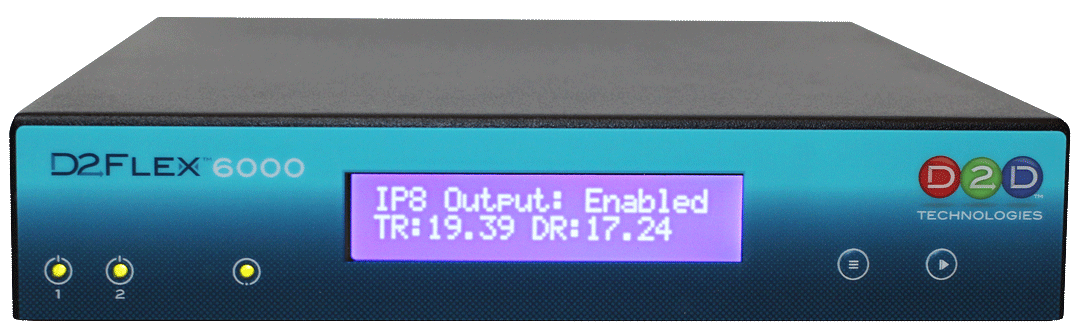
Jacksonville, FL May 10, 2017 – D2D Technologies is the recipient of a NewBay Media Best of Show award presented by TV Technology at the 2017 NAB Show. The D2Flex Video Processor and Broadcast Gateway builds on D2D’s highly regarded D2Mux Multiplexer with increased I/O, full SMPTE 2022 support, encoder/decoder modules, and a clear roadmap to ATSC 3.0.
“D2D Technologies is honored to receive NewBay’s Best of Show Award from TV Technology at the 2017 NAB Show”, said Steve Doll, President, D2D Technologies. “With the spectrum auction coming to an end, whether you are building out construction permits or upgrading existing facilities, the D2Flex can meet all your multiplexing needs while providing a software upgrade path to a Broadcast Gateway/Scheduler when you are ready to make the switch to ATSC 3.0.”
The D2Flex 6000 can easily merge local content, both compressed and uncompressed, with national channels using robust digital video processing of service components from any input to create a tailored digital output stream. Demanding bandwidth constraints can be met by removing unwanted elementary streams like secondary audio or even dropping complete programs. Broadcasters who receive DVB streams can easily convert to the necessary ATSC format on any output stream.
The D2Flex 6000 is also a full duplex ASI/IP network video gateway that can remultiplex up to 16 input streams received over ASI or Gigabit Ethernet and create 16 independent IP output streams with configurable Forward Error Correction (FEC) that is compliant with SMPTE 2022-1/2/7. Network jitter and errors in transmission are corrected in the receiving system to recreate the original transport stream. Conversion from IP to ASI is supported on up to 7 independent ASI outputs.
The D2Flex 6000 supports up to 4 channels of HD encoding or 8 channels of SD encoding. The uncompressed video can be received on both SDI or Gigabit/10Gigabit Ethernet in compliance with SMPTE 2022-5/6.
Broadcasters who need to regionalize their channels for local markets can easily control the PSIP/SI branding of their transmission and optionally insert an Electronic Program Guide (EPG) so that viewers can find the programs they want. The D2Flex 6000 can set the major and minor channel numbers on each output stream and pass through or regenerate the necessary PSIP tables. The optional D2Guide can run on the D2Flex platform to provide dynamic PSIP data insertion from popular services like Titan TV and Gracenote (TMS) or from a spreadsheet with programming for the next several weeks.
The D2Flex 6000 provides flexible I/O configuration options including up to seven ASI/SDI inputs and up to seven ASI/SDI outputs. Digital streams over IP are handled by the two standard RJ45 Gigabit Ethernet ports and can be optionally expanded with two additional GigE or 10GigE ports. Browser based management of the D2Flex is done over a dedicated Ethernet (GigE) control port that supports SNMP remote monitoring with configurable traps.
Availability and Pricing
The D2Flex 6000 Video Processor and Network Gateway is available immediately from D2D Technologies. Customers can purchase the base D2Flex 6501 with 1 input and output IP stream, 5 ASI inputs and 2 ASI outputs starting at $4,995. Options for additional IP Stream multiplexing, ASI I/O, Electronic Program Guide (EPG) with D2Guide and Emergency Alert EAS insertion with D2Alert are also available. For more information visit http://www.d2dtechnologies.com/products/d2flex6000/
About the NewBay Best of Show Award, Presented by TV Technology
NewBay’s Best of Show Awards are evaluated by a panel of engineers and industry experts, and are selected based on innovation, feature set, cost efficiency and performance in serving the industry. Winners are featured in TV Technology, the digital television authority, serving the broadcast, cable, production, post production, business and new media markets. For more information, visit http://www.tvtechnology.com/nab-show/0026/tv-technology-announces-2017-nab-best-of-show-award-winners/280937
About D2D Technologies
D2D Technologies specializes in solutions that transform digital video for reliable contribution and content distribution in broadcast, cable, satellite and IPTV markets. We have built our reputation by delivering reliable and high value products including the D2Mux 5020 series of digital HD/SD MPEG Multiplexers. The D2Mux transforms MPEG-2 and MPEG-4 services from ASI and Gigabit Ethernet into a tailored transport stream ready for distribution over ASI, IP and SMPTE-310. So whether we are working in the most demanding contribution and distribution environments, or providing a cost effective solution for your needs, D2D Technologies delivers solutions that are truly Transforming Digital Video. Contact: www.D2DTechnologies.com, toll free 844-D2D-TECH or call 904-323-4777.
###
Editor’s note: You can download this press release along with other information from D2D Technologies at www.d2dtechnologies.com/news
D2D Technologies™, D2Flex™, D2Mux™, D2Guide™ and D2Alert™ are trademarks of D2D Technologies, LLC.